
Bits & Pieces
Edition #301 | 16/10/2026
Most Traded | What we're watching | JPMorgan | Chart of the Week | PE corner | Commodity-ETFs | Retirement in Focus
Publicly listed companies in the US are opening their books once again. Rising inflation, shifting yields, and volatile oil prices are bound to leave their mark – or are they? As is tradition, the major banks kicked off earnings season, led by JPMorgan. This week, we take a closer look at how these financial powerhouses actually make their billions. Meanwhile, a familiar name has cracked the top five of the Nasdaq 100: Elon Musk. Plus, we show you how to turn heated commodity prices into an opportunity for your portfolio.
This newsletter contains ads.
Note: The data refers to the ratio of purchases and sales of the 100 most traded stocks on Scalable Broker between 09/10/2026 and 15/10/2026.
In the spotlight: TSMC
So much for AI fears: Taiwan Semiconductor Manufacturing Co. (TSMC) delivered its sixth consecutive quarter of record net profit in Q3 2026, reaching roughly $23.6 billion – an impressive jump of nearly 70%. At the same time, the world’s leading semiconductor foundry plans to significantly ramp up its capital expenditure, which currently stands at over $60 billion per year.
Peak ahead – what comes after?
Sentiment on Wall Street remains undeniably bullish: analysts are projecting year-over-year earnings growth of up to 30% for the S&P 500 in Q3. According to FactSet, more companies are issuing positive guidance than at any point since 2006. However, this apparent boom is heavily skewed by two familiar growth engines:
The AI wave: Driven by massive tech spending, the semiconductor sector alone is expected to boost profits by an extraordinary 130%.
The oil spike: High commodity prices have catapulted year-over-year growth expectations for the energy sector to 121%.
The problem: This tailwind is likely reaching its peak right now. Wall Street forecasts for upcoming quarters point noticeably downward, with earnings growth potentially halving by mid-2027. If macroeconomic headwinds catch up with these projections, markets could face a rude awakening.
The silver lining: This setup creates prime territory for contrarian investors. As growth normalises over the next few quarters and analysts lower the bar, something very healthy happens to the market: valuations come back down to earth. A cooling off of overheated expectations doesn't mean the bull market is over – it simply makes stocks more reasonably priced and far more attractive entry points for fresh capital.
How to bank
As is tradition, major banks kicked off the US earnings season, led by industry giant JPMorgan. While the bank generated $50.9 billion in revenue – an 8% year-over-year increase – it wasn't quite enough to beat Wall Street’s elevated expectations. Like many of its peers, America's largest bank generates revenue from three core pillars:
Community Banking: Under the Chase brand, the bank serves over 86 million consumer clients and 7.4 million small businesses globally, offering checking accounts, savings products, mortgages, and loans. Profit here is driven by net interest margin – paying lower interest on deposits and lending capital out at higher rates. This segment accounted for 42% of total revenue.
Investment Banking: This unit advises corporations on M&A deals and guides companies through IPOs and capital raises, alongside active stock and bond trading. Driven by elevated market volatility in Q3, investment banking delivered $22.7 billion in revenue – representing nearly 45% of the quarterly total.
Asset & Wealth Management: Managing assets for high-net-worth individuals and institutional investors yields steady management fees. This segment recently contributed $6.9 billion.
Potential tailwinds: The Trump administration aims to ease regulatory requirements, potentially lowering capital reserve mandates for banks. This would free up significant capital for core lending operations – or boost shareholder returns via dividends and stock buybacks.
Conquest, Musk-style
Nasdaq 100 index weighting in %
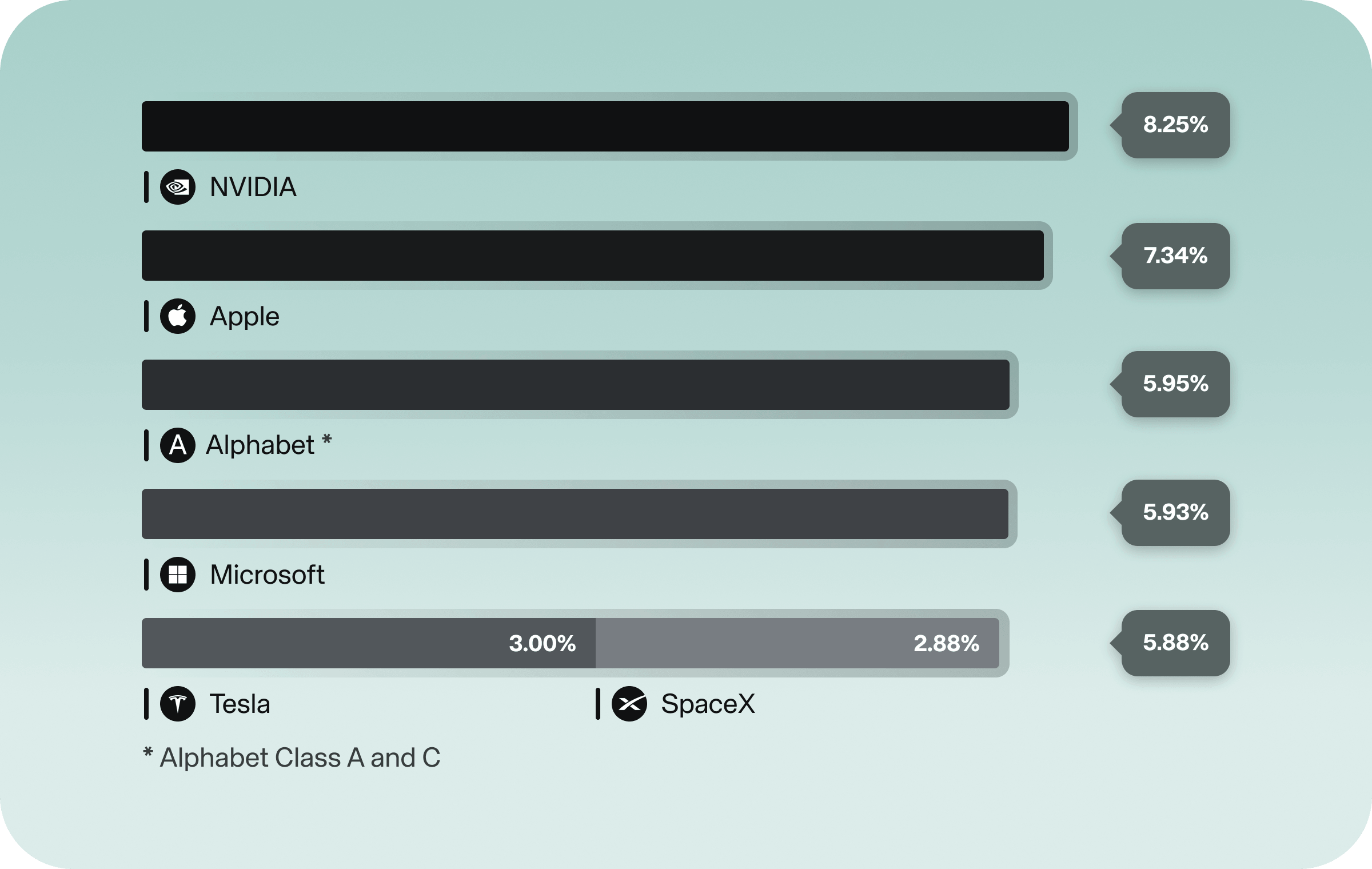
Source: iShares as of 13th October, 2026
Electric vehicles, tunneling, rockets – and now cellular networks? Elon Musk is shaking up another industry. With SpaceX acquiring wireless spectrum for its Starlink satellite network, the company is quietly evolving into a serious telecom rival. In response, shares of established giants like AT&T, T-Mobile US and Verizon took a hit. Meanwhile, cell tower operators such as American Tower and Crown Castle are eyeing multi-billion-dollar infrastructure contracts.
Musk’s expanding footprint via SpaceX is also reshaping the Nasdaq 100. Combined, his two publicly listed companies – SpaceX and Tesla – now rank as the 5th largest heavyweight in the index, sitting nearly neck-and-neck with Alphabet and Microsoft.
SpaceX's rising index weight stems largely from the expiration of lock-up periods for early venture investors, significantly increasing its free float. As additional lock-up periods expire, the stock's index weighting is expected to climb even further during December's rebalancing.
In the coming weeks, the team from DealsCrunch will share key Private Equity updates in this section.
Schneider acquires tech firm PTC
Schneider Electric recently announced its $22.6 billion acquisition of US-based software provider PTC. Shareholders were initially lukewarm on the price tag, but here’s why we find the deal compelling:
From blueprint to shop floor: Auto and aerospace manufacturers rely on PTC to design their products. Schneider already supplies the hardware and control software for the actual manufacturing process. Moving forward, both companies will cross-sell to each other's client bases – a clear win-win scenario. Schneider plans to issue up to €17 billion in new debt and up to €6 billion in new equity to finance the takeover – capital that some investors would have preferred to see deployed into organic R&D.
Our take: Acquiring PTC allows Schneider to build predictable, recurring subscription revenue streams over many years, even when clients aren't building new factories. While this smooths out earnings volatility, the added debt load means Schneider will need to deliver clear EPS growth to justify the deal.
What's next: Schneider reports quarterly earnings today, where management may offer clearer timelines on when these promised synergies will translate into revenue.
If you want to dive deeper, check out milton, the app by morningcrunch – tailored specifically to your portfolio.
Harnessing inflation
When prices rise at the pump or the grocery checkout, it pays to look at the companies benefitting on the other side. Investing in these sectors offers a natural hedge against broad inflation.
The Xtrackers MSCI World Energy UCITS ETF offers direct exposure to the global oil and gas industry. If fuel prices tick up at Shell stations, you can participate in that margin expansion rather than just paying for it at the pump. When global commodity prices rise, corporate margins often follow – Shell, for instance, reported a 75% margin expansion between Q2 and Q3.
From copper to specialty chemicals, the Amundi S&P Global Materials Screened UCITS ETF provides exposure to the raw materials powering global industry. Holdings include mining giant Rio Tinto and industrial gas supplier Linde, with an ESG screening process applied to exclude non-compliant issuers.
The iShares Agribusiness UCITS ETF covers the entire agricultural value chain. From fertiliser producers like Nutrien to machinery makers like John Deere, this ETF tracks the companies securing global food production and distribution networks.
In this section, we provide quick, direct answers to your key questions about the proposed retirement savings account for Germany.
I’ve made up my mind to switch from my Riester plan to an AVD (retirement account). What are my options?
Option 1: You open an AVD and transfer your existing Riester balance into it. This unlocks higher long-term return potential for both your existing capital and future contributions, while giving you access to more flexible payout options. Note: While a full transfer makes sense for many investors, individual tax and subsidy situations should be carefully reviewed first. Scalable will offer a streamlined online transfer service where you simply provide a few basic contract details, and we take care of the rest.
Option 2: You leave your existing balance and capital guarantees intact in your current Riester contract, while directing all future monthly savings into a new AVD to capture better growth. Key consideration: Once you open an AVD, new government allowance rules apply across all your existing Riester and AVD accounts, so be sure to check how this impacts your total allowances beforehand.
Multiple Riester contracts: If you hold multiple Riester accounts, you can decide individually for each contract whether to keep or transfer the balance. Under current regulations, eligible government support is capped at a maximum of two accounts per investor.
Editorial deadline: Friday, 7 a.m.
Sources: Scalable and dpa-AFX