
Bits & Pieces
Edition #302 | 23/10/2026
Most traded | What’s on our mind | Streaming | VIP Watch | Chart of the Week | Active ETFs | Scalable News | Retirement in Focus
While Elon Musk dreams of trillion-dollar revenues, we look at the impact of the US midterms on the markets and track live sports events on Netflix. Also: why Victoria’s Secret is getting even sexier.
This newsletter contains ads.
Sold
Note: The data refers to the ratio of purchases and sales of the 100 most traded stocks in the Scalable broker between 16/10/2026 and 22/10/2026.
In the spotlight: adidas
Strong sales of athletic footwear and a €200m US tariff refund drove record Q3 results for adidas – lifting shares slightly. For the full year, the sportswear maker now expects an operating profit of €2.5bn, up from €2.3bn.
Battle for Washington
The US midterm elections take place on 3 November. Why should you care? Because your portfolio almost certainly has US exposure. Ahead of the vote, US market volatility usually rises due to uncertainty over the outcome, often benefiting defensive sectors. Once the dust settles, cyclical sectors and small caps typically get a boost.
Shuffling the deck. Held halfway through a four-year US presidential term, the midterms determine the balance of power in Congress. Specifically, one-third of the Senate (upper house) and all 435 seats in the House of Representatives (lower house) are up for election – both currently controlled by Republicans. Polls suggest the Democrats could take the House. The result would be a divided Congress, leaving Donald Trump without a majority on key issues such as the budget, taxes or defence.
All clear. According to experts, this scenario would be market-neutral or even slightly positive, as it reduces the likelihood of sweeping reforms. What's more, midterms usually trigger only short-lived volatility. Over the long term, economic trends, corporate earnings, monetary policy and AI investments carry far more weight.
Plot twist in the numbers
Netflix is ramping up its content lineup: with three NFL games across Thanksgiving and Christmas, alongside the Fury vs Joshua boxing match, the streaming giant is branching out into live sports.
However, the past quarter dampened the excitement. Although Q3 margins climbed by over 6 percentage points year-on-year to nearly 35%, this was primarily driven by a one-off tax charge that hit 2025 earnings. Adjusted margin improvement was just roughly 1%. A weaker outlook for Q4 further weighed on sentiment.
A silver lining: Netflix plans to launch its ad-supported tier in 15 new countries by 2027 to boost advertising revenue.
Bringing sexy back
Hillary Super is betting on "sexy in all forms". Since taking over at Victoria’s Secret in 2024, the CEO has been revamping the lingerie label's image. Replacing outdated perfectionism, she is putting sex appeal back at the core – reinterpreted with diversity and self-empowerment in mind.
That pivot is visible on Wall Street now, too: since June, Victoria’s Secret stock has traded on the NYSE under the ticker VSXY (formerly VSCO), the "XY" a nod to the "Very Sexy" product line. The strategy seems to be working, with the share price on the rise again.
The bull market turns four!
Four stocks have accounted for nearly half of the total S&P 500 return year-to-date
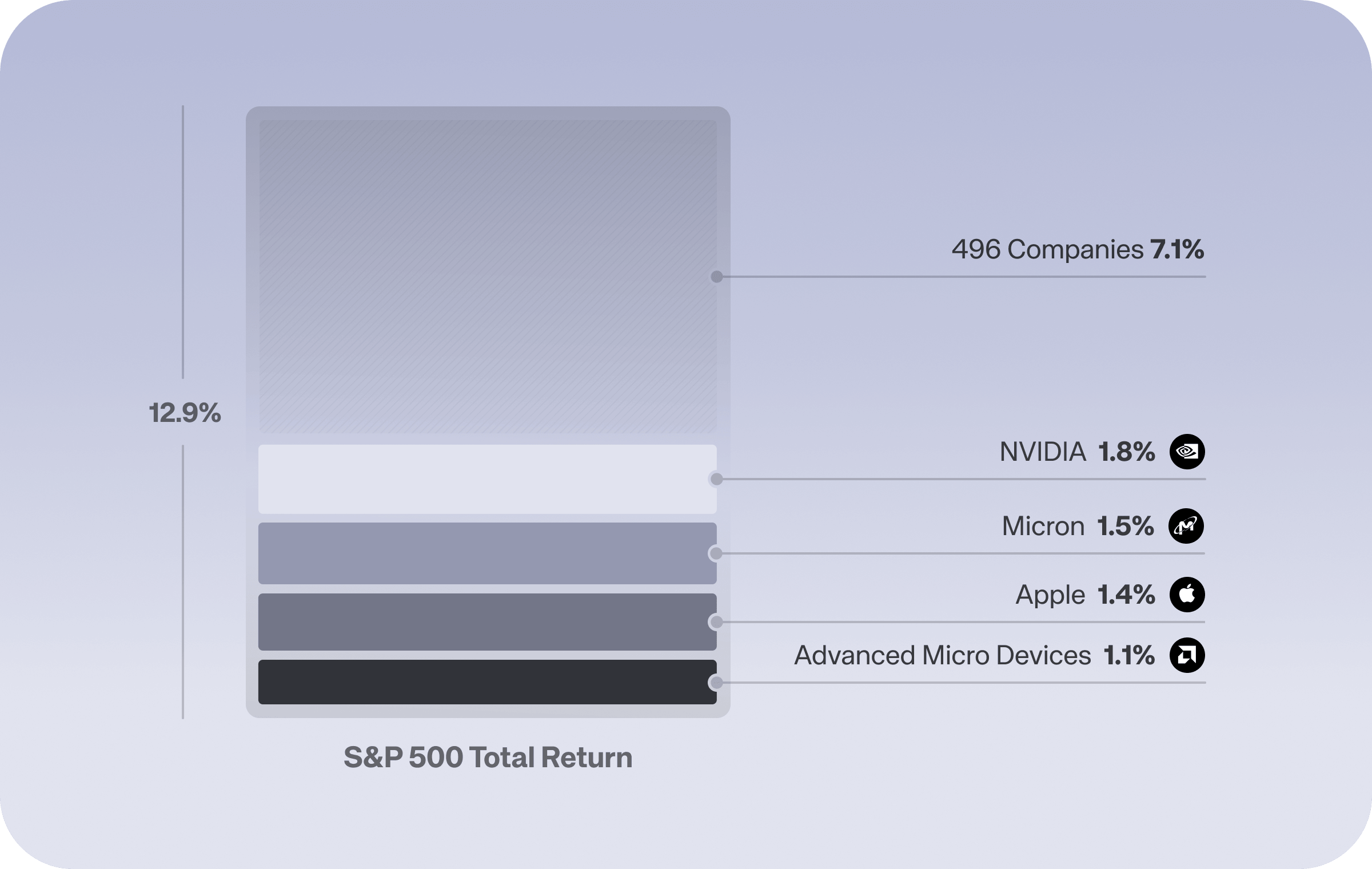
Source: Bloomberg, Barron’s calculations
Since hitting rock bottom in October 2022, the subsequent turnaround – fueled by the launch of ChatGPT and the AI boom – has seen the S&P 500 notch up record after record as it celebrates four years of a bull market. Yet the foundation remains narrow: of the 12.9% year-to-date return, almost half comes from just four tech stocks. Together, they contributed 5.8 percentage points, while the remaining 496 stocks accounted for the rest.
An active airbag
The recent turbulence in US tech stocks likely left its mark on many portfolios. In times like these, active ETFs become attractive thanks to their ability to respond flexibly to market trends. Unlike passive ETFs, active ones allow managers to aim to outperform the market through targeted stock or bond selection. For instance, in a high-interest-rate environment, a fund holding both asset classes can rotate capital from volatile equities to high-yielding bonds.
While active ETFs generally carry higher total expense ratios (TERs), they offer active risk management and greater flexibility than index-tracking ETFs, ideally delivering outperformance.
Double the benefit
Hit the ground running together: refer Scalable to a friend. For a limited time, both of you will bag a €25 bonus. Simply copy and share your personal referral link in the Scalable app.
In this section, we provide quick, direct answers to your key questions about the proposed retirement savings account for Germany.
The Bundestag has passed the early-start pension scheme ("Frühstartrente"). What is planned?
Children whose primary residence is in Germany will receive €10 per month from the state from their 6th to their 18th birthday – totaling €1,440 per child. The scheme is scheduled to launch on 1 January 2027, starting with the 2020 (retroactive for 2026) and 2021 birth cohorts.
Important for parents: You open a certified custody account in the child's name with your chosen provider. Once parental consent is given, the provider automatically handles the grant application. The €10 is then paid directly into the account every quarter – with no personal contribution required. However, parents, grandparents or relatives can voluntarily contribute up to €6,840 per year. All returns and gains remain tax-free during the accumulation phase.
From 1 January 2027, Scalable will offer the best deal for your child's financial future under the early-start pension scheme. Note: The legislative process in parliament is still ongoing. Find out more here.
Editorial deadline: Friday, 7 a.m.
Sources: Scalable and dpa-AFX