Multi-Asset ETFs: Smart Diversification
June 30, 2026 |

Marketing Material
A solid portfolio rarely stands on just one pillar. If one asset class struggles, others can help balance the impact – that’s the basic idea of diversification. Once investors have added broad equity ETFs, the next question often follows: what else belongs in a well-diversified portfolio?
Whether diversification truly enhances stability is illustrated by a Morningstar study. It compares a traditional 60/40 portfolio (60% S&P 500, 40% government bonds) with a pure equity portfolio over a 150-year period. During the Great Depression starting in 1929, the US equity market declined by around 79%, whereas a 60/40 portfolio fell by approximately 53%. Over the full 150-year period, Morningstar* identified 19 bear markets for equities, compared with only 11 for the 60/40 portfolio.
One notable exception remains 2022. In that year, both equities and bonds came under pressure simultaneously, as central banks raised interest rates at the fastest pace seen in decades. In this case, a 60/40 portfolio took noticeably longer than a pure equity portfolio to return to its previous peak. Diversification can therefore mitigate volatility – but not eliminate it.3
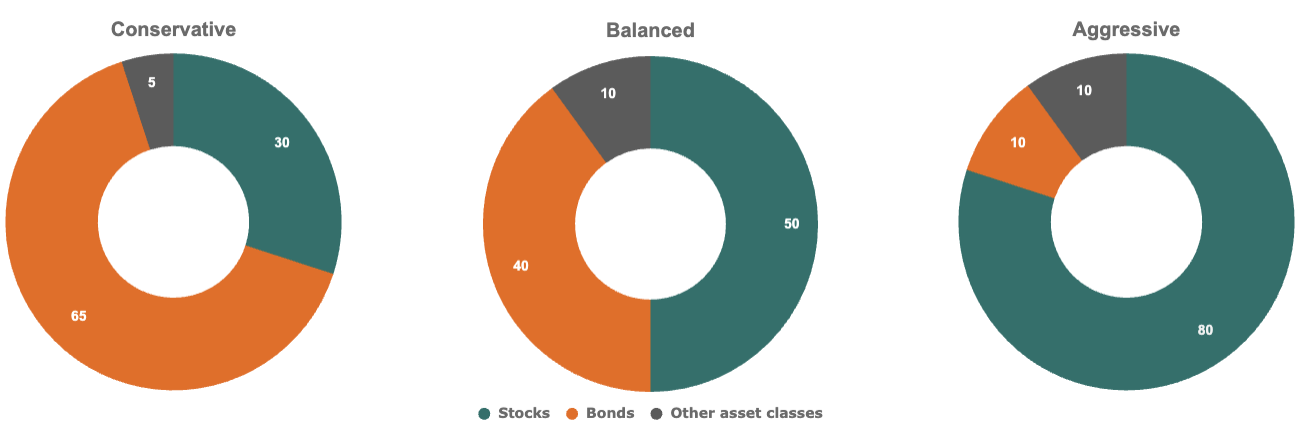
The appropriate allocation depends less on market forecasts and more on individual circumstances: investment horizon, risk tolerance, and life stage. Investors with a long time horizon – such as 40 years until withdrawal – may be better positioned to tolerate fluctuations and could therefore adopt a more growth-oriented profile with 80–90% equities. Conversely, investors focusing on preserving accumulated wealth may prefer a more defensive allocation with 30–40% equities and a higher bond component.
Between these extremes lie balanced allocations with 50–70% equities, often complemented by modest exposure to commodities, gold, or more specialised asset classes such as REITs* ( Real Estate Investment Trusts), which are typically required to distribute a large portion of their rental income as dividends. The chart below illustrates various positioning examples for multi-asset ETFs.
Source: DWS Investment GmbH, 2026.
For investors seeking exposure to multiple asset classes without continuously managing allocations themselves, so-called multi-asset ETFs may offer a solution. The allocations shown (see Chart 1) can be implemented through a single product. These ETFs combine equities, bonds and – in some cases – commodities according to a predefined target allocation. As market movements shift these weights, portfolios are rebalanced at regular intervals – typically quarterly or semi-annually – to restore the original mix.
This rebalancing process enforces a disciplined, often counter-cyclical investment approach, which can be difficult to maintain individually. Some strategies follow strict allocation rules, while others allow for tactical adjustments by the management team (active multi-asset ETFs). The implications of the equity allocation for long-term wealth accumulation can be summarised succinctly: the lower the equity share, the smoother the potential return profile – though typically with lower long-term return potential. A higher equity allocation may offer greater return opportunities, but is likely to come with more frequent and pronounced fluctuations. Multi-asset ETFs can help reduce the ongoing management effort; however, the fundamental decision regarding acceptable volatility remains. This is precisely where their value lies: they can make it easier to stay committed to a chosen investment strategy, even through more challenging market phases.
1 UBS, 2025, Global Investment Returns Yearbook 2025, accessed on May 3, 2026
2 Bloomberg, 2026, Bloomberg Global-Aggregate Total Return Index Value Unhedged USD, accessed on May 3, 2026
3 Morningstar, 2026, The 60/40 Portfolio: A 150-Year Markets Stress Test, accessed on May 3, 2026
Interest rate cycles: The interest rate cycle describes the recurring fluctuations of interest rates over time – phases of rising and falling rates.
Morningstar: Morningstar is an independent financial research and analysis firm providing data, analytics and ratings on funds, ETFs and equities to support investment decisions.
REIT: A Real Estate Investment Trust (REIT) is a listed property company that enables investors to invest indirectly in real estate and participate in rental income and profits.
All opinions reflect the current assessment and may change without prior notice. Forecasts are based on assumptions, estimates, views and hypothetical models or analyses that may prove to be inaccurate. Past performance is not a reliable indicator of future performance. Source: DWS International GmbH; as of 18 May 2025. CR: 110346
Risk Disclaimer – There are risks associated with investing. The value of your investment may fall or rise. Losses of the capital invested may occur. Past performance, simulations or forecasts are not a reliable indicator of future performance. We do not provide investment, legal and/or tax advice. Should this website contain information on the capital market, financial instruments and/or other topics relevant to investment, this information is intended solely as a general explanation of the investment services provided by companies in our group. Please also read our risk information and terms of use.